

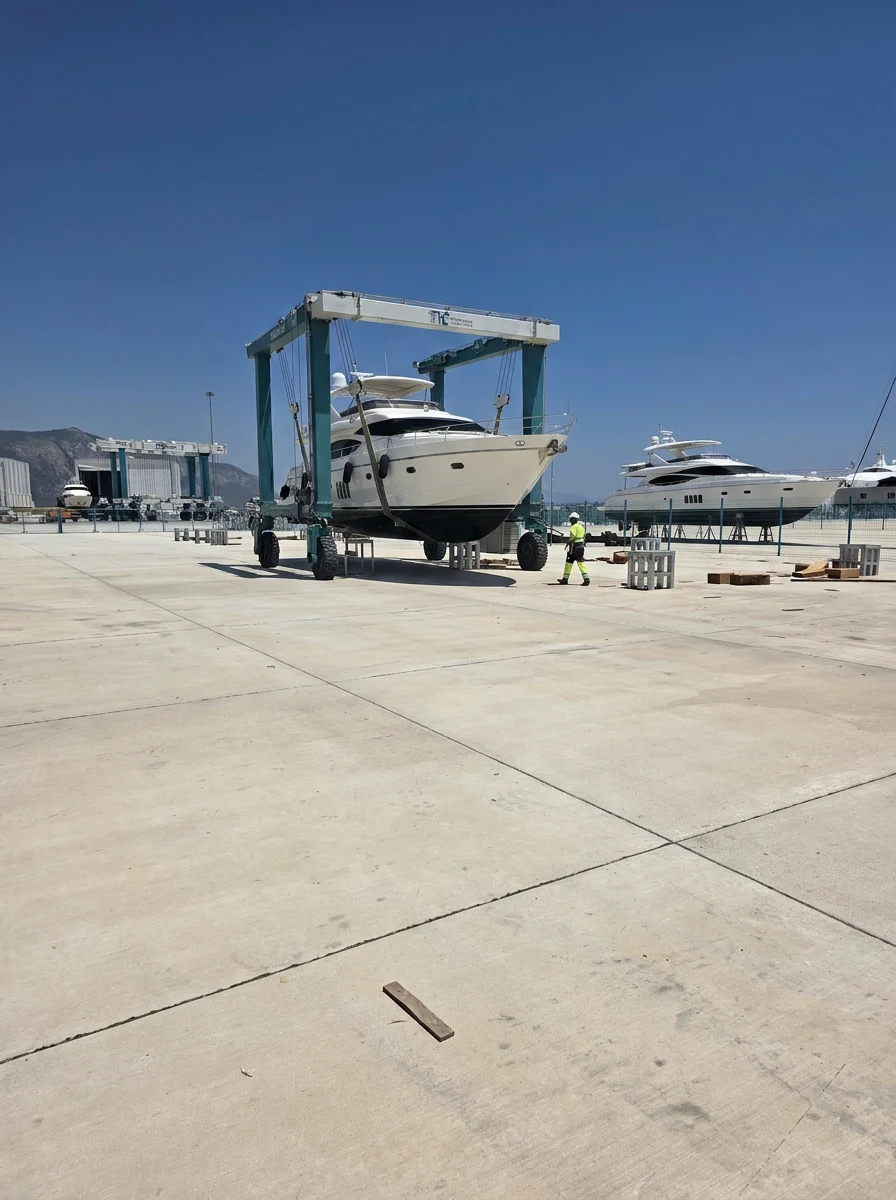
Hauling out means lifting the boat from the water and supporting it safely ashore. It may look like a simple crane movement, but it is the step that determines the loads carried by the hull and sets up a stance that will last all winter.
Preparing for the lift
There are things to be done before lift day begins:
- The boat’s current weight and draught figures are needed to position the slings.
- The appendages under the hull — shaft, propeller, transducer, stabiliser, log — determine where the slings can go; if the boat has a lifting plan, it should be shared.
- The fuel and water tanks are usually run down, which lowers both the centre of gravity and the total weight.
- A short list is made covering seacocks, navigation equipment and loose gear.
The lift and sling positions
Travel lift slings are not placed at random. They must bear on parts of the hull able to carry the load and must not touch the shaft, propeller or rudder. Wrongly placed, they leave local pressure points and marks on the hull as it is lifted.
The lift is slow and controlled. With the boat in the air, the hull bottom is fully visible for the first time, and this is the most valuable moment for a survey: blister marks, cracks, cavitation erosion and the state of the anodes are all photographed now.
Washing the hull: why immediately?
The hull is washed the moment the boat comes out of the water. The reason is simple: growth and weed come away easily while wet, but once dry they set on the surface like a crust, become hard to remove and risk damaging the paint.
Once the surface has dried after washing, the condition of the antifouling can be seen. The thickness of the paint build-up and its adhesion determine the next step; renewing the antifouling is planned after this assessment.
Blocking and the winter stance
Ashore, the boat is supported on blocks under the keel and stands at the sides. The keel carries most of the load; the stands provide balance, not support.
- The number and placement of stands follow the length of the boat and the shape of the hull.
- The ground must be firm; on ground softened by rain the stands sink in and the balance is lost.
- Long lay-ups call for periodic checks: wind, temperature swings and ground settlement all loosen the stands.
Winter lay-up checklist
- Winter servicing of engine and generator: oil, filters and the cooling circuit.
- Draining the water system, with antifreeze in any line at risk of freezing.
- The condition of the batteries and a charging plan.
- Ventilation: a closed, damp interior means mould, so use a dehumidifier and keep the air moving.
- Cover tension: a slack tarpaulin chafes and wears the gelcoat, while one stretched tight cannot breathe.
- A list of jobs for the start of the season — work planned in winter does not end up in the spring queue.
For the lay-up calendar and periodic checks, see our yacht maintenance calendar as well.



 Bodrum Beton
 Bodrum Boru
 İTS Maden
 İTS Gıda